WarpQuant: Dual-Domain LLM Quantization via Hadamard Rotation and Output-Fisher Sensitivity
WarpQuant creates INT3 weights in a rotated coordinate system and uses Output-Fisher sensitivity in the original coordinates to choose which columns to recover. A TurboQuant-style KV cache and per-token INT8 activations extend the same design to the three memory paths of M=1 decoding.
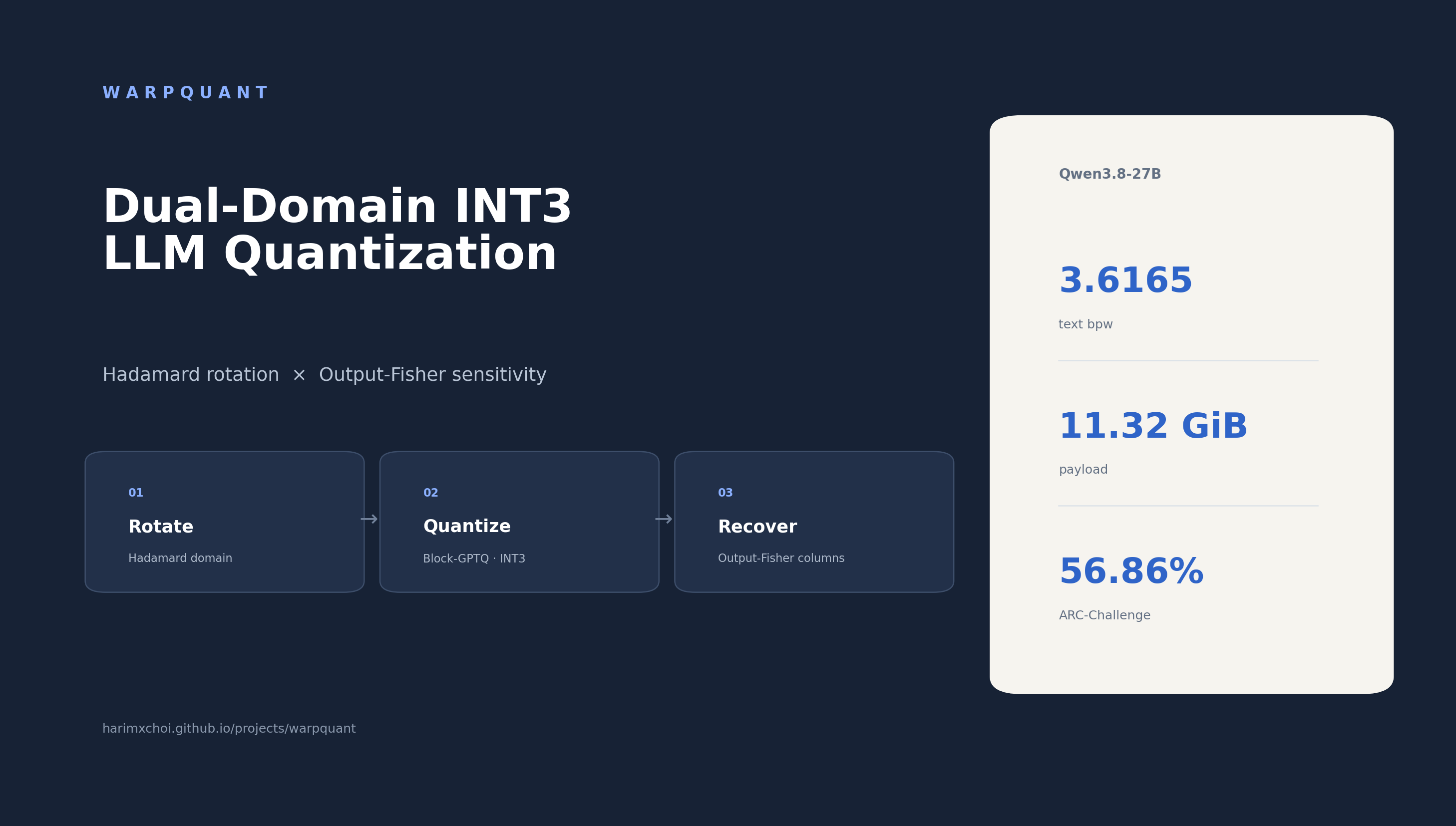
Definition: quantize three memory paths separately
Autoregressive decoding streams weights for every token, accumulates a KV cache with context length, and moves activations through each linear operation. WarpQuant does not force one bit-width onto tensors with different distributions and lifetimes.
Design: compress in the rotated domain, recover in the original domain
A deterministic signed Hadamard transform R=HD rotates each weight matrix W. The rotated weights use 128-column groups, a Gaussian Lloyd-Max 3-bit codebook, FP16 scales, and block-GPTQ error feedback into later groups. [1][4][5]
- 1:
Construct the signed Hadamard rotation R ← HD
- 2:
Wr ← WRT, Xr ← XRT
- 3:
(Ŵr, codes, scales) ← BlockGPTQQ3,G128(Wr, Xr)
- 4:
W̃ ← ŴrR, E ← W − W̃
- 5:
sc ← HX,ccE:,cTdiag(HG)E:,c / (16dout + 32)
- 6:
Select columns C by descending sc under the global budget B
- 7:
return codes, scales, C, E:,C
In R16E4H4, R16 restores selected weak columns in BF16, while E4 and H4 store the token embedding and lm_head in group-128 INT4. This connects the 3.55-bpw projection design to the payload of the complete text model.
Selecting recovery columns with Output-Fisher
Recovery priority is not determined by weight error alone. Input activation energy H_X, quantization residual E, and the squared output NLL gradient H_G estimate how strongly each column's error reaches next-token loss. [8]
Here W_base is the block-GPTQ reconstruction mapped back to the original coordinates. The column score used by the selector is defined by the following PyTorch function.
import torch

def output_fisher_score(W, W_base, X, H_G, index_bits=32):
    assert W.ndim == W_base.ndim == 2
    assert X.shape[-1] == W.shape[1]
    assert H_G.shape == (W.shape[0],)

    E = W.float() - W_base.float()
    H_X = X.float().square().mean(dim=0)
    loss_weighted_error = (
        H_G.float()[:, None] * E.square()
    ).sum(dim=0)
    cost_bits = 16 * W.shape[0] + index_bits
return H_X * loss_weighted_error / cost_bitsBecause output directions are not treated uniformly, the budget shifts toward loss-sensitive regions such as v_proj and down_proj. At the same Llama 3 8B payload, WikiText-2 perplexity moves from 7.3953 to 7.3446.
Results: Qwen3.8-27B text backbone
The denominator is 26,895,998,464 text-generation parameters, excluding the vision tower and MTP. Commonsense is the macro average of fixed 1,000-item samples from HellaSwag, WinoGrande, and PIQA.
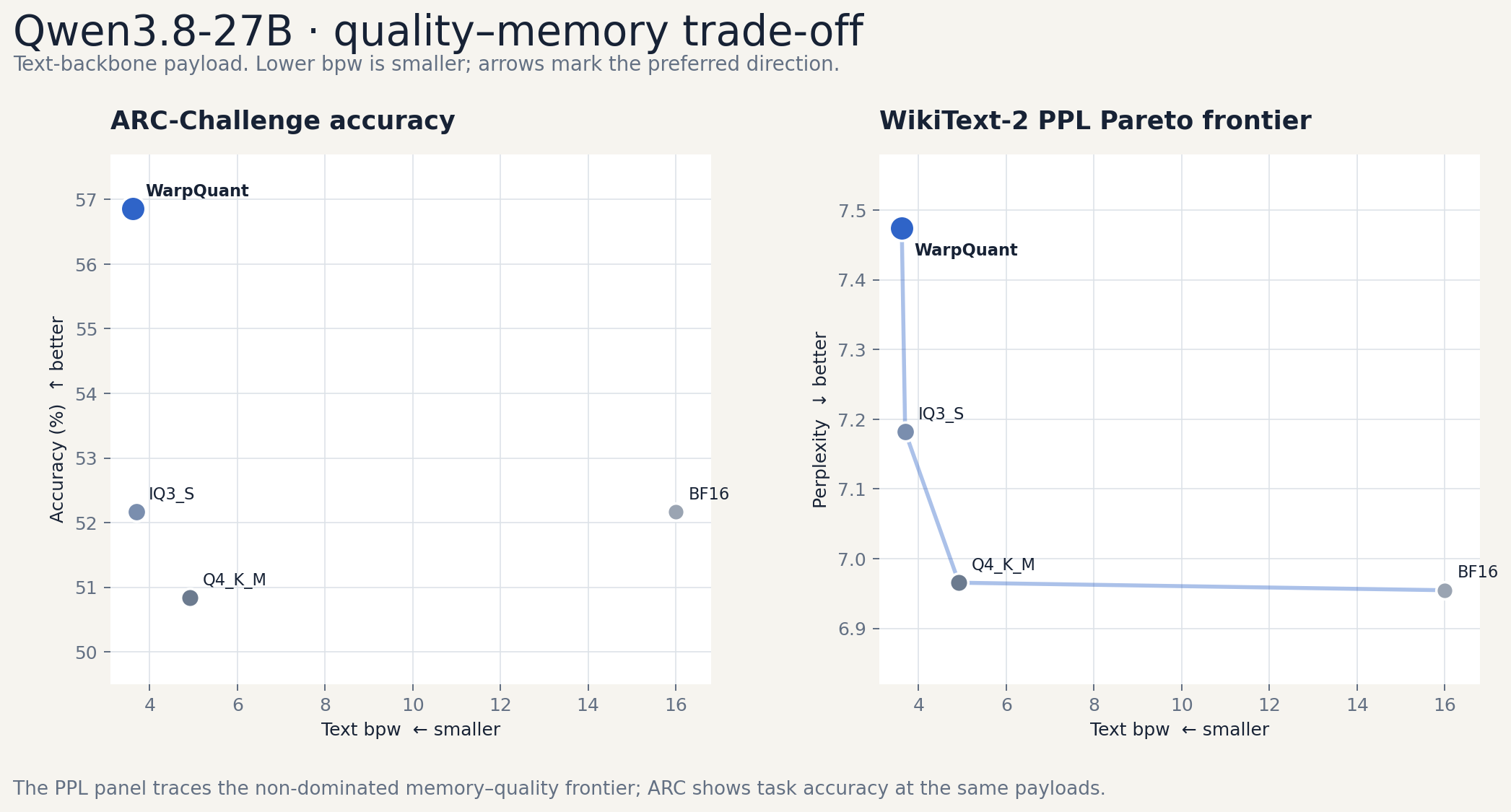
| Format | Text bpw | Payload | WT2 PPL ↓ | ARC-299 ↑ | MMLU-13,943 ↑ | Commonsense ↑ | GSM8K-500 flex ↑ |
|---|---|---|---|---|---|---|---|
| BF16 | 16.00 | 50.11 GiB | 6.9548 | 52.17 | 43.07 | 79.23 | 70.40 |
| Q4_K_M | 4.92 | 15.41 GiB | 6.9656 | 50.84 | 42.90 | 79.23 | 75.20 |
| IQ3_S | 3.6940 | 11.57 GiB | 7.1820 | 52.17 | 42.97 | 78.83 | 59.40 |
| WarpQuant R16E4H4 | 3.6165 | 11.32 GiB | 7.4737 | 56.86 | 42.72 | 78.83 | 61.00 |
PPL, ARC, and MMLU use the same llama.cpp evaluation path. GSM8K uses the same first 500 examples and 5-shot prompts for all four models; the table reports lm-evaluation-harness flexible-extract accuracy.
The same format comparison on other models
On Qwen3.5-4B, WarpQuant is 243.6 MB smaller than IQ3_M while improving PPL, ARC, and MMLU. On Llama 3 8B, it is 43.0 MB smaller than IQ3_S and scores higher on ARC, while IQ3_S retains better PPL and MMLU.
| Format | Text bpw | Payload | WT2 PPL ↓ | ARC-299 ↑ | MMLU ↑ |
|---|---|---|---|---|---|
| BF16 | 16.00 | 7.846 GiB | 8.3885 | 45.82 | 39.58 |
| Q4_K_M | 5.13 | 2.523 GiB | 8.5472 | 48.83 | 39.48 |
| IQ3_M | 4.09 | 2.015 GiB | 10.6976 | 42.81 | 37.41 |
| WarpQuant Fisher R16E4 | 3.6514 | 1.788 GiB | 9.2494 | 46.15 | 38.13 |
| Format | Text bpw | Payload | WT2 PPL ↓ | ARC-299 ↑ | MMLU ↑ |
|---|---|---|---|---|---|
| BF16 | 16.00 | 14.965 GiB | 6.2559 | 50.50 | 41.04 |
| Q4_K_M | 4.89 | 4.583 GiB | 6.4359 | 50.84 | 40.67 |
| IQ3_S + imatrix | 3.66 | 3.429 GiB | 6.9929 | 44.15 | 39.87 |
| WarpQuant Fisher R16E4H4 | 3.6256 | 3.389 GiB | 7.3446 | 45.49 | 38.99 |
KV cache and activations
Across Qwen3.8-27B's 16 full-attention layers, the newest 128 tokens stay in BF16. Older keys use a 3-bit MSE code plus a 1-bit QJL residual after random rotation; values use per-token group-32 INT4. This applies TurboQuant's online inner-product quantization to the KV cache. [9][10][11][12]
Activations use a per-token absolute-maximum scale for inputs to 496 decoder linear modules. The table compares weight-only, KV, A8, and combined paths on the same Qwen3.8-27B R16E4H4 checkpoint and 4,088 WikiText-2 validation tokens. [13][14]
| Configuration | PPL ↓ | Δ PPL | Top-1 | KV @ 512 |
|---|---|---|---|---|
| WarpQuant weight-only | 6.6468 | — | reference | 1.00× |
| + K4/V4/R128 | 6.6495 | +0.0027 | 97.65% | 2.14× |
| + Dynamic A8 | 6.7139 | +0.0671 | 92.10% | 1.00× |
| + K4/V4/R128 + A8 | 6.6945 | +0.0477 | 92.47% | 2.14× |
Measurement and reproduction
GGUF baselines use their physical text-model rate and payload. WarpQuant sums packed codes, FP16 scales, weak-column indices and residuals, plus embedding/head group scales. Its evaluation checkpoint is a BF16 carrier containing the same quantized values.
Relationship to prior work
References
[3]Sehoon Kim et al. “SqueezeLLM: Dense-and-Sparse Quantization.” ICML, 2024.
[11]Zirui Liu et al. “KIVI: A Tuning-Free Asymmetric 2bit Quantization for KV Cache.” ICML, 2024.
Citation
@misc{choi2026warpquant,
  author       = {Harim Choi},
  title        = {WarpQuant: Dual-Domain LLM Quantization via Hadamard Rotation and Output-Fisher Sensitivity},
  year         = {2026},
  url          = {https://harimxchoi.github.io/projects/warpquant}
}