Vargo
Agent routing hits an identification wall · verified execution reaches the deployable ceiling
Built with Python · ALFWorld · Agent routing · Verifier cascade · Reproducible evaluation
WHY
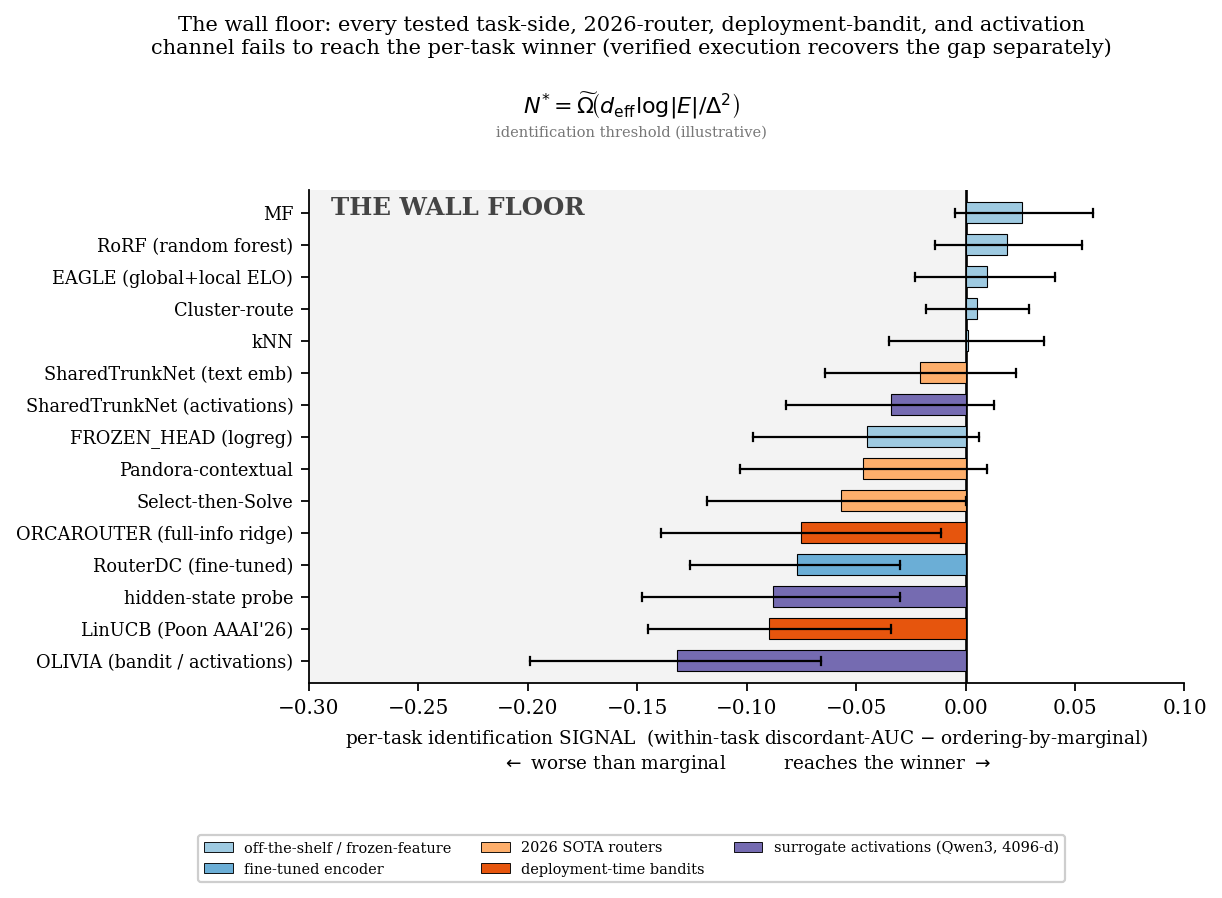
The best combination of agent scaffold, memory, retry, and verifier changed from task to task. Could task text, embeddings, or hidden states identify that best configuration before any candidate was run? If not, the practical question became how much of the performance gap could be recovered by executing and verifying a limited number of candidates.
ALFWorld tasks × agent configurations
Best per-task configuration vs. one fixed setup
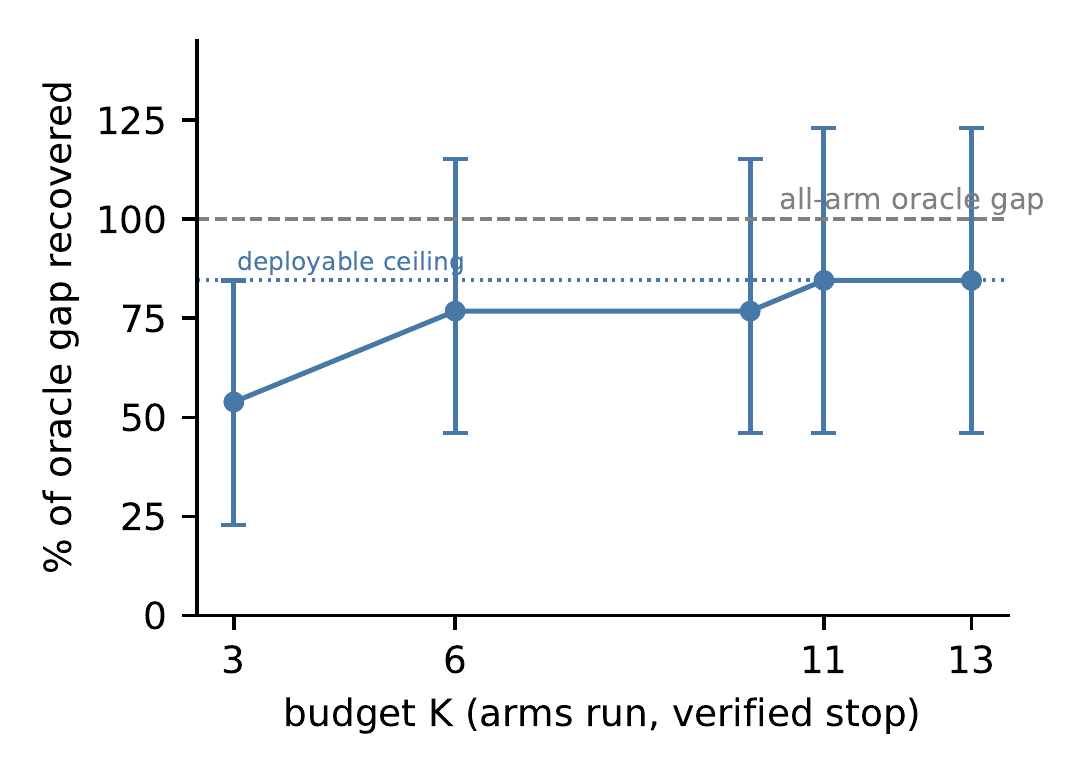
Recovered oracle gap; 100% in the K=11 deployable pool
HOW
Replace winner prediction with bounded execution and verification
The system stops asking which configuration looks best and instead asks whether a candidate has produced a verifiable success.
- 01 Task and candidates
Hold the task fixed and enumerate the reasoning, memory, retry, and verification configurations that can execute it.
- 02 Fixed execution order
Run candidates under a bounded budget rather than training another selector on an unstable ranking signal.
- 03 Outcome verifier
Check the environment result after each attempt and distinguish certified success from plausible-looking traces.
- 04 Early stop
Return the first verified success together with its execution record; otherwise expose the exhausted budget.
RESULT
Two different decision problems
| Approach | Signal available | Observed outcome |
|---|---|---|
| Pre-execution routing | Task text, embeddings, hidden states, bandit feedback | Could not identify the per-task winner |
| Verified execution | Actual candidate outcomes under bounded budget | Reached the deployable ceiling at K=11 |
Contribution
- Built the 134-task × 29-configuration evaluation matrix and separated oracle headroom from what a deployable selector can actually identify.
- Implemented routing baselines, activation probes, contamination controls, and verified-execution capture evaluation; the resulting paper is under review at TMLR.
Evidence
Private project